How to keep track of in-laws
You grew up learning your own family. Your spouse's family you were handed all at once.
Short answer
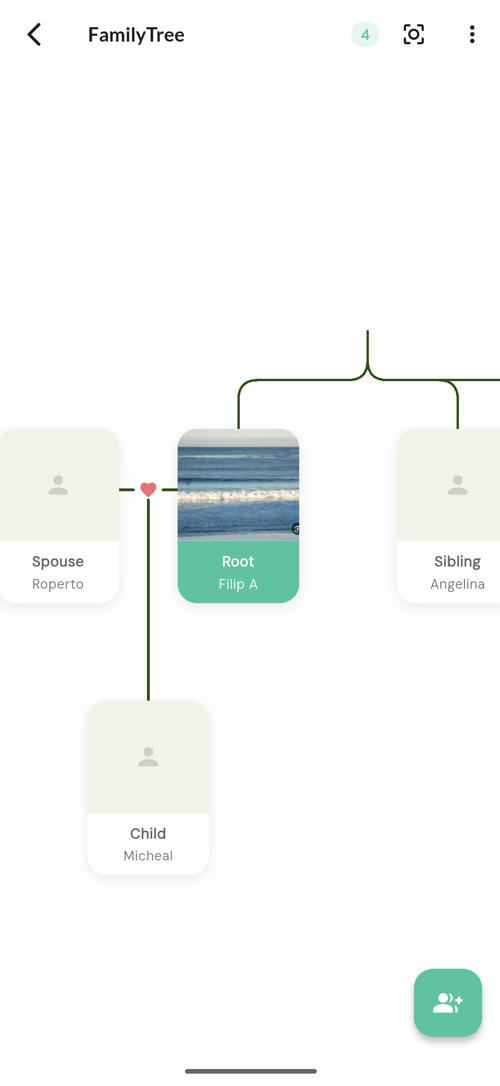
Map your spouse's family as its own branch rather than trying to merge it into yours. Start by recording your spouse, then their parents, then their siblings, and let the in-law relationships follow from those links instead of entering each one by hand. Put that branch in its own group so it stays scannable, and record the spouses of their siblings too — those are the people whose names go first and whose connection is hardest to hold on to.
Build the branch from your spouse outward
Every in-law relationship you have runs through one person. Record your spouse first, then their parents and siblings; everything else hangs off those three links.
You never need to record "mother-in-law" as such. Record that she is your spouse's mother, and the relationship to you follows.
Give it its own group
A group called something like "Wife's family" keeps the branch legible and makes it obvious who you have not yet added.
Groups are shared spaces, so this also becomes the natural place for the people in it to see each other.
Record the siblings' spouses
Brothers-in-law and sisters-in-law by marriage are the hardest group to keep straight, because they carry no shared surname and no shared childhood.
They are also the ones most likely to ring you out of the blue, which is exactly when a relationship-aware caller card earns its keep.
Add the context as you meet people
A key date for a wedding anniversary, a tag for the city they live in, a note after a gathering. These are cheap at the time and impossible to reconstruct later.
Frequently asked questions
Is there an "in-law" relationship type?
No, and there does not need to be. In-law relationships are derived from marriage plus blood relationships, which TreeLinker records directly.
Can I keep my spouse's family separate from mine?
The tree is one graph, since the families really are connected through your marriage. Groups are what let you view and manage each side separately.
What about step-families?
Use the relationship types that apply — parent, child, spouse, relative — and the 'other' type where nothing fits.
TreeLinker — a family relationship management app.
Related pages
How to organise relatives
How to split an extended family into groups that stay useful, and when a private tag is the better tool.
Family tree
An interactive family tree you can zoom and pan, built from your contacts, with colour-coded relationship types and automatic reciprocal links.
A relationship manager for the people you actually know
Record how the people in your life are connected, see the path between any two of them, and keep a timeline of what has happened with each one.
Start with the contacts you already have
TreeLinker is free on Google Play. No ads, no subscription, and your address book never leaves your phone.
Android. Free. No account required to browse your own contacts.