Caller identification
Placement, not identification.
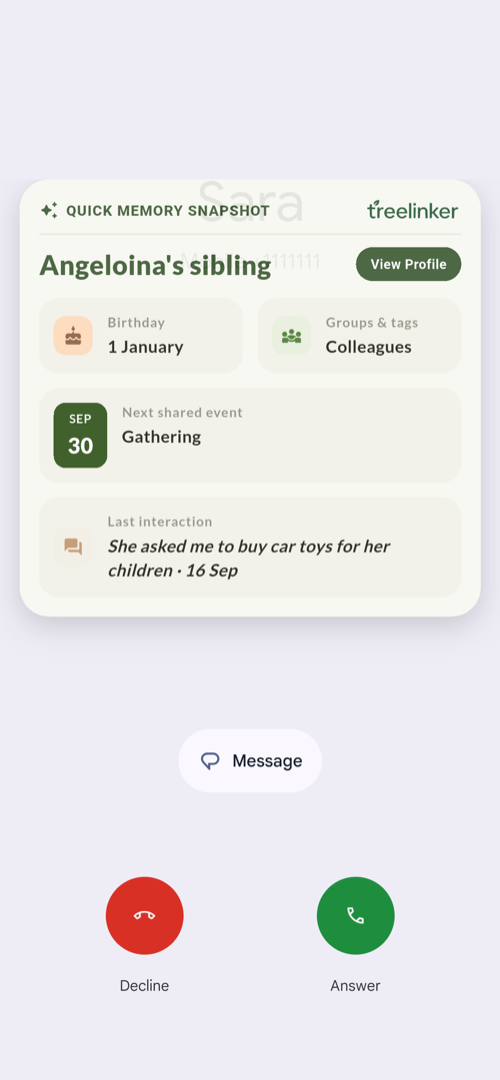
Short answer
When someone already in your contacts calls, TreeLinker shows a card with their name and how they are connected to you — for example "Nadia — sibling of Safa". Everything on it is read from your own device. There is no phone-number database, nothing is fetched while the phone rings, and if the caller is not someone you already know, no card is shown at all.
Only people you already have
TreeLinker cannot name a stranger and does not try. A service that answers "who owns this number" lets anyone walk the number space and harvest identities, so TreeLinker never built one.
The Caller Name section
Each contact shows exactly what will appear when that person calls. TreeLinker recommends it from your recorded relationships; you can accept, edit or clear it. It is private, and never shown to the person it describes.
Permissions it uses
Android's call screening role, so the incoming number is visible, and permission to display over other apps so the card can appear. TreeLinker never requests call log access.
Calls on the timeline
An incoming call from someone you know is recorded on that contact's timeline, so the history of contact builds itself.
Frequently asked questions
Does it identify unknown numbers?
No, deliberately.
Does it block spam?
No.
Is it available on iPhone?
No. iOS has no equivalent call screening role.
TreeLinker — a family relationship management app.
Related pages
Caller ID that never uploads your contacts
Most caller ID apps work by uploading everyone's address book into a shared database. TreeLinker does not have one. It shows how a caller is related to you, using only the contacts already on your phone.
Relationships
Seven relationship types, automatic reciprocal links, and suggestions with confidence scores and plain-language explanations.
Contacts
Your phone's address book, read on device, searchable, and extended with relationships, groups, tags, timelines and memories.
Start with the contacts you already have
TreeLinker is free on Google Play. No ads, no subscription, and your address book never leaves your phone.
Android. Free. No account required to browse your own contacts.